

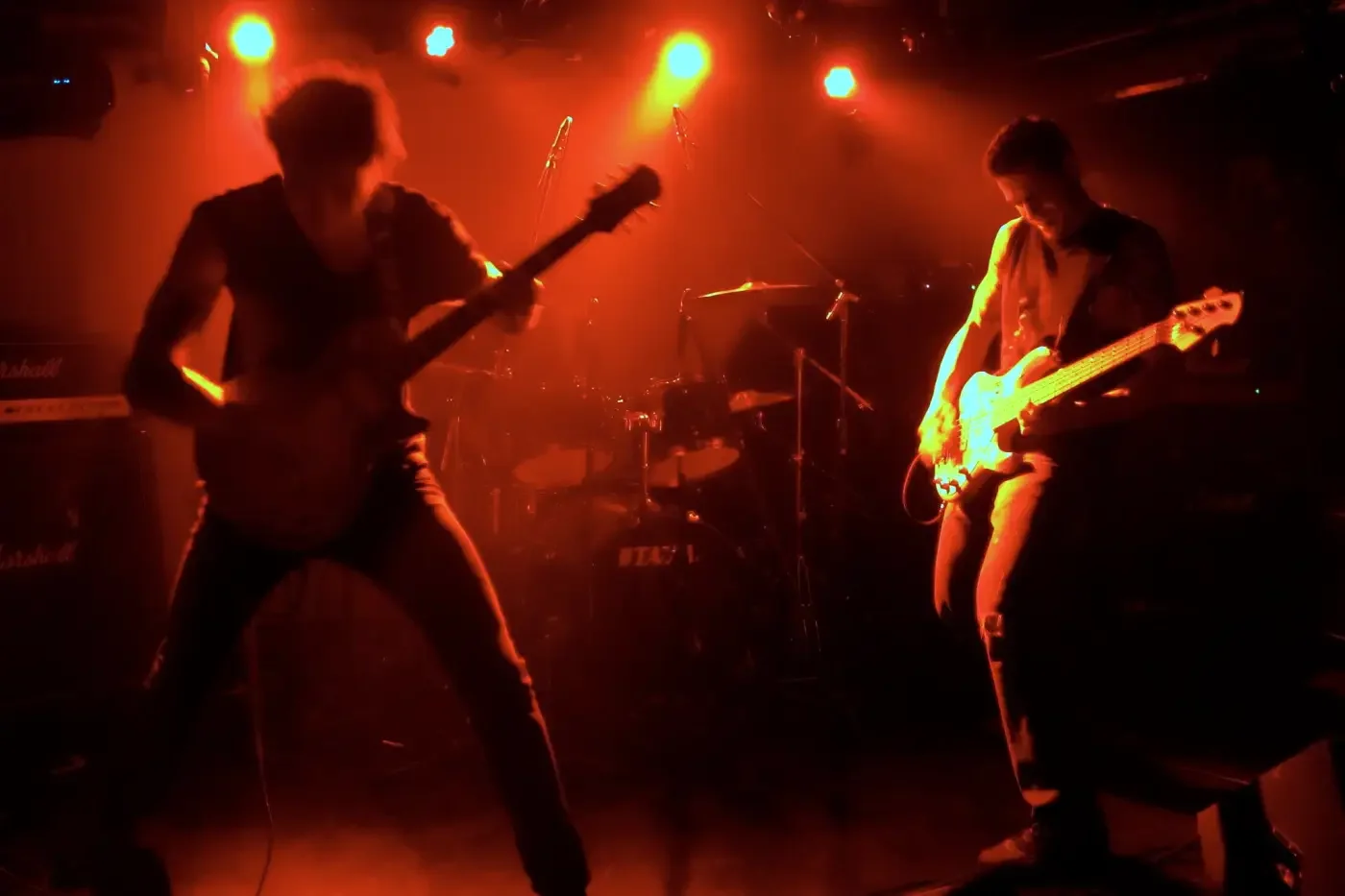
Funeral Sutra marked a decisive turn. Where earlier work moved on instinct and momentum, this project slowed everything down, not to soften it, but to concentrate it. Speed gave way to pressure held in place. Motion collapsed into form. The two began working inside fixed shapes, allowing tension to build by refusing release.
This was the first time limitation became intentional. Songs stopped behaving like narratives and started functioning as structures. Repetition replaced fracture. What emerged was not minimalism for its own sake, but a deliberate reduction. The question was no longer how much energy could be generated, but how long it could be held without breaking.
Funeral Sutra
When Speed Became Weight
Funeral Sutra stripped urgency down to its core components. Patterns stayed narrow and unmoving while strain accumulated around them. The effect was suffocating in the best way, forcing attention onto the space between notes rather than the notes themselves.
This approach taught its members how little material is actually required to create force. A single figure, repeated without relief, could carry more impact than constant variation. That lesson became fundamental, shaping how they later approached rhythm and pacing inside Worship Pain.
Ritual Black Metal Without Excess
Funeral Sutra pulled from black metal but refused most of its excess. The focus stayed on clear lines, steady patterns, and a narrow emotional temperature. Guitars held cold harmonic frames. Bass locked the ground and rarely left it. The surface seemed simple, but the strain sat underneath. This approach taught them how to let repetition carry force and how to avoid hiding weak ideas behind ornament. That discipline is still present in Worship Pain.
Funeral Sutra developed under the same physical constraints that shaped much of their work. Small rehearsal rooms. Volume pressed hard against the walls. In those conditions, silence stopped being neutral. It felt carved out, almost violent in its absence.
The band began treating those gaps as part of the composition. Held moments and sudden stops became structural elements rather than pauses. Writing with negative space taught them how to control impact without adding density. That understanding of silence later became central to how Worship Pain handles transitions, breaks, and restraint.
Environment, Silence, and Shape
The Line From Funeral Sutra to Worship Pain
Funeral Sutra sits between the post-hardcore roots of Black Line Fever and the controlled force of Worship Pain. It is the point where their method turned inward, where motion became discipline and ritual took the place of constant movement. The structural habits they formed here never left. In Worship Pain, their work still carries the same cold focus, the same restraint, and the same refusal to waste sound.